





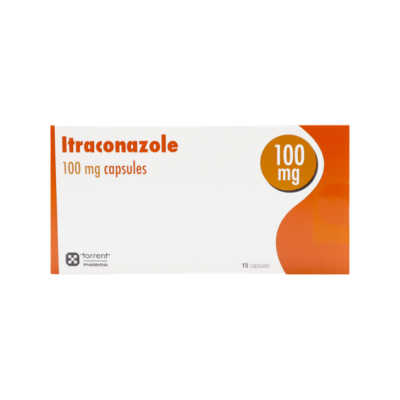
Itraconazole Capsules

- Broad-spectrum
- Lasting protection
- Highly effective

Itraconazole Capsules
Category:Nail ProblemsItraconazole is a powerful, broad-spectrum oral antifungal medication used to treat stubborn fungal infections of the fingernails and toenails. It is especially effective for infections that have not responded to topical paints or lacquers, as it works systemically to kill the fungus living deep within the nail bed and the nail itself.
Fetching Data...



Frequently Asked Questions for Itraconazole Capsules
What is Itraconazole?
Itraconazole is a prescription-only oral antifungal medicine belonging to the triazole class, used to treat a range of fungal infections including onychomycosis (fungal nail infection). Taken as a capsule, it is absorbed into the bloodstream and delivered to the nail through the body's circulation, treating the infection from within.
Itraconazole has a broader antifungal spectrum than terbinafine — it is active against dermatophytes (the most common cause of nail infection), yeasts including Candida, and many non-dermatophyte moulds. This makes it particularly useful when the causative organism is not a standard dermatophyte, or when terbinafine has not been effective.
How does Itraconazole work?
traconazole works by inhibiting the fungal enzyme 14α-demethylase (a CYP51 enzyme), which is essential for converting lanosterol to ergosterol — the primary structural component of fungal cell membranes. Without ergosterol, the fungal cell membrane becomes defective and permeable, impairing cellular function and killing the fungus.
Because itraconazole is a highly lipophilic (fat-soluble) molecule, it accumulates in keratinised tissues — including the nail plate and nail bed — at concentrations significantly higher than those in the blood. Importantly, therapeutic concentrations persist in nail tissue for several months after treatment is stopped, which is why the pulse dosing regimen (intensive short courses followed by treatment-free intervals) is clinically effective.
Who is Itraconazole suitable for?
Itraconazole for fungal nail infection is appropriate for adults with confirmed or clinically suspected onychomycosis — particularly:
- Those with non-dermatophyte or yeast nail infections
- Those who have not responded to terbinafine
- Those for whom terbinafine is contraindicated
- Those with mixed dermatophyte and yeast infections
Itraconazole is not suitable if you:
- Are allergic to itraconazole, other azole antifungals, or any excipient in the capsule
- Have a history of heart failure or ventricular dysfunction — itraconazole has a negative inotropic effect and should be avoided in patients with or at risk of heart failure
- Have significant liver disease — itraconazole is hepatically metabolised and should be used with caution; rare cases of serious hepatotoxicity have been reported
- Are pregnant or planning to become pregnant — itraconazole is teratogenic and must not be used in pregnancy; effective contraception is required during treatment and for 2 months after
- Are breastfeeding — itraconazole is excreted in breast milk
- Are taking any contraindicated medicines (see drug interactions below)
Critical drug interactions — do not take itraconazole alongside:
- Statins metabolised by CYP3A4: simvastatin, lovastatin — risk of serious myopathy and rhabdomyolysis; these statins must be stopped during itraconazole treatment
- Certain anticoagulants: direct oral anticoagulants (DOACs) including apixaban, rivaroxaban, dabigatran — significantly increased bleeding risk; warfarin levels also affected
- Terfenadine, astemizole, cisapride, pimozide, quinidine — risk of life-threatening cardiac arrhythmia (QT prolongation)
- Midazolam (oral), triazolam — severe sedation
- Certain antiepileptics: carbamazepine, phenytoin, phenobarbital — reduce itraconazole levels significantly (may make treatment ineffective) and levels of these medicines may also be affected
- Rifampicin — reduces itraconazole levels
- Colchicine — increased colchicine toxicity
- Digoxin — increased digoxin levels
This is not a complete list. Itraconazole is a potent CYP3A4 inhibitor and substrate — always declare your full medication list during consultation.
Dosage and how to take Itraconazole
All prescribed medication should be used in accordance with your prescriber's instructions.
Important: Itraconazole capsules must be taken immediately after a full meal — food (particularly fatty food) significantly increases absorption. Taking on an empty stomach can reduce blood levels by up to 40%.
Continuous dosing:
- 200mg (typically two 100mg capsules) once daily with food
- Fingernails: 6 weeks; toenails: 12 weeks
Important:
- Do not take on an empty stomach — this significantly reduces efficacy
- Complete the full prescribed course — do not stop early even if the nail appears to be improving
- The fungus continues to be killed during rest weeks (pulse regimen) due to persistence of itraconazole in nail tissue
- Using triptans on more than 10 days per month risks medication overuse headache — not applicable here but declare all concurrent medications
Side effects of Itraconazole
Itraconazole is generally well tolerated at the doses used for nail infection, but carries a more complex side effect and interaction profile than topical treatments.
Common:
- Nausea, stomach discomfort, or diarrhoea
- Headache
- Skin rash or itching
Uncommon:
- Elevated liver enzymes (usually reversible)
- Dizziness
- Oedema (swelling, particularly of the legs)
- Menstrual irregularities
Rare but serious:
- Hepatotoxicity (liver toxicity) — rare but potentially serious; monitor for jaundice, dark urine, or persistent abdominal pain
- Heart failure — itraconazole has a negative inotropic effect; avoid in patients with impaired cardiac function
- Peripheral neuropathy — numbness or tingling in the hands or feet; stop treatment if this occurs
- Severe skin reactions — including Stevens-Johnson syndrome (very rare)
- Hypokalaemia (low potassium) — particularly with longer treatment courses
Seek urgent medical attention if you experience:
- Yellowing of the skin or eyes (jaundice)
- Significant oedema or shortness of breath (may indicate cardiac effects)
- Severe or blistering skin rash
- Numbness or tingling in the extremities
Contraindications, warnings and drug interactions
Do not take Itraconazole if you:
- Are allergic to itraconazole or any azole antifungal
- Have a history of or current heart failure or ventricular dysfunction
- Have severe liver disease
- Are pregnant, planning pregnancy (use effective contraception during and for 2 months after), or breastfeeding
- Are taking any contraindicated medicine (see full list above and in PIL)
Use with caution if:
- You have any degree of hepatic impairment — liver function monitoring may be required
- You are elderly — increased sensitivity to side effects
- You take any regular prescription medicines — itraconazole has one of the widest drug interaction profiles of any oral antifungal
Absorption interaction: Medicines that reduce gastric acid — including proton pump inhibitors (omeprazole, lansoprazole), H2 blockers (ranitidine), and antacids — can significantly reduce itraconazole absorption. If you take any of these, declare them during your consultation.
Pregnancy: Itraconazole is classified as teratogenic — it must not be used in pregnancy. Women of childbearing potential must use effective contraception during treatment and for 2 months after the last dose.
More FAQs
Q: What is itraconazole used for in fungal nail treatment? Itraconazole is a prescription oral antifungal that treats fungal nail infections (onychomycosis) by working systemically — absorbed into the bloodstream and delivered to the nail through the circulation. It is active against dermatophytes (the most common cause), yeasts including Candida, and non-dermatophyte moulds, giving it a broader spectrum than terbinafine.
Q: What is pulse dosing and why is it used? Pulse dosing involves taking itraconazole intensively for one week, then stopping for three weeks, then repeating the cycle. It works because itraconazole accumulates in nail tissue at high concentrations and persists there for months after the blood level has dropped — so the drug continues to kill the fungus during the rest weeks. Pulse dosing achieves similar clinical outcomes to continuous daily dosing but with a shorter total tablet-taking period.
Q: How does itraconazole compare to fluconazole for nail infections? Both are triazole antifungals but they differ in spectrum, dosing, and interaction profile. Itraconazole has a broader spectrum — effective against dermatophytes, yeasts, and moulds — and offers pulse dosing for a shorter treatment duration. Fluconazole is dosed weekly over a longer period and has a somewhat different interaction profile (primarily CYP2C9 and CYP3A4 vs itraconazole's predominantly CYP3A4). The choice depends on the organism, your other medications, and your medical history. Your prescriber will advise.
Q: Does itraconazole interact with my other medicines? Itraconazole is one of the most interaction-prone oral antifungals — it is a potent CYP3A4 inhibitor, meaning it can significantly increase the blood levels of many other medicines. Critical interactions include: simvastatin and lovastatin (must be stopped — risk of muscle damage), direct oral anticoagulants (DOACs — increased bleeding risk), certain antiepileptics, some heart rhythm medicines, and others. A full medication review is essential before prescribing. Always declare every medicine you take during the consultation.
Q: Must I take itraconazole with food? Yes — this is clinically important. Itraconazole capsules must be taken immediately after a full meal. Food — particularly fatty food — significantly increases absorption. Taking on an empty stomach can reduce absorption by up to 40%, which would reduce efficacy. Do not take with antacids or acid-suppressing medicines at the same time — these also reduce absorption.
Q: Is itraconazole safe during pregnancy? No. Itraconazole is classified as teratogenic — it must not be used during pregnancy. Women of childbearing potential must use effective contraception during treatment and for two months after completing the course. Always disclose pregnancy or pregnancy plans during the consultation. The prescriber will not issue this medication if pregnancy cannot be excluded.
Q: Can itraconazole cause liver problems? Itraconazole is metabolised by the liver, and rare cases of serious liver toxicity have been reported. Patients with pre-existing liver disease should use it with caution and under closer monitoring. Seek medical attention if you develop symptoms suggestive of liver problems during treatment — including jaundice (yellowing of skin or eyes), dark urine, persistent abdominal pain, or unusual fatigue.
Q: Is itraconazole suitable if I have heart problems? Itraconazole has a negative inotropic effect — it can reduce the pumping strength of the heart. It should be avoided in patients with a history of heart failure or ventricular dysfunction. If you have any cardiac history, declare this fully during your consultation. This is the most important cardiac consideration unique to itraconazole among the oral antifungals.
Q: How long does it take to see results? As with all systemic antifungals for nail infection, results are gradual — the healthy nail must physically grow out and replace the infected tissue. Most patients begin to see clear nail growing from the base within 2 to 4 months. Full results for toenails may not be apparent until 12 to 18 months after starting treatment (including the time for the nail to fully grow out after treatment is complete). The treatment itself is much shorter than this — typically 12 weeks continuous or 3 pulse cycles for toenails.
Q: Can the infection come back after treatment? Yes — recurrence rates for nail infection are significant even after successful treatment. To reduce reinfection risk: treat any concurrent athlete's foot, keep feet dry, use breathable footwear, and avoid walking barefoot in communal areas. Using an antifungal foot powder after completing oral treatment may help prevent reinfection.