





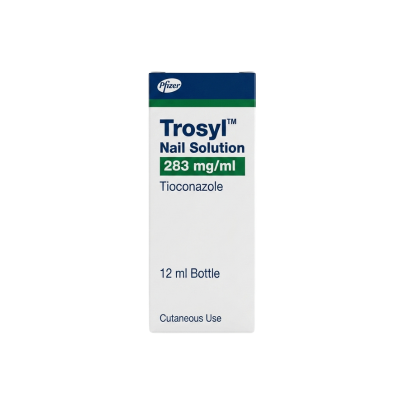
Trosyl Nail Solution

- High Concentration
- Targeted Action
- Treats the surrounding skin

Trosyl Nail Solution
Category:Nail ProblemsTrosyl is a high-strength prescription nail solution (lacquer) used to treat fungal nail infections (onychomycosis). Unlike over-the-counter creams, it contains a high concentration of the antifungal agent tioconazole, which is designed to penetrate the hard keratin of the nail to reach the site of infection in the nail bed.
Fetching Data...



Frequently Asked Questions for Trosyl Nail Solution
What is Trosyl?
Trosyl is a topical nail solution containing tioconazole 28% w/v — a high-concentration imidazole antifungal applied directly to the nail surface and surrounding skin. It is used to treat fungal nail infections (onychomycosis) by delivering antifungal medicine directly to the site of infection without entering the bloodstream.
Trosyl comes in a small bottle with an integrated brush applicator, allowing precise application to the affected nail and the nail fold. It is specifically formulated for nail infections — the high concentration of tioconazole (28%) is significantly stronger than many standard topical antifungals and is designed to penetrate the nail plate to reach the fungus beneath.
Unlike oral antifungals such as fluconazole or terbinafine, Trosyl acts locally — it does not enter the systemic circulation in clinically meaningful quantities, which means it carries no drug interaction risk and is suitable for many patients who cannot take oral antifungal medicines due to other medications or health conditions.
How does Trosyl work?
Tioconazole is an imidazole antifungal that works by inhibiting the synthesis of ergosterol — a key structural component of fungal cell membranes. Without ergosterol, the fungal cell membrane becomes defective and permeable, disrupting normal fungal cell function and ultimately causing fungal cell death.
At 28% concentration, Trosyl is formulated to penetrate the nail plate — the hard, keratinised structure that typically acts as a barrier to topical medicines. The solution is absorbed through the nail surface and reaches the nail bed and underlying nail plate where the fungal infection resides.
Tioconazole is active against the dermatophyte fungi most commonly responsible for nail infections (principally Trichophyton rubrum and Trichophyton mentagrophytes), as well as certain yeasts and non-dermatophyte moulds.
Because the medicine acts locally at the nail surface rather than systemically through the bloodstream, it does not interact with other medicines and does not place any additional burden on the liver or kidneys.
Trosyl vs oral antifungal treatment — which is right for you?
Both topical solutions like Trosyl and oral antifungals like fluconazole can treat fungal nail infections — but they work differently and suit different patients and presentations.
Trosyl (tioconazole 28% topical solution):
- Applied directly to the nail — acts locally, not systemically
- No drug interactions — suitable for patients on multiple medications
- No liver or kidney burden — appropriate for patients with organ impairment
- Best suited to mild to moderate infections, early-stage cases, or single nail involvement
- Treatment course: typically 6 months for fingernails, 12 months for toenails
- Requires consistent daily application throughout the treatment course
- Lower systemic side effect risk
Fluconazole (oral prescription antifungal):
- Taken by mouth — distributed through the bloodstream to the nail bed
- Significant drug interaction profile — warfarin, statins, antiepileptics and others
- Requires liver and kidney assessment
- More effective for moderate to severe infections, multiple nail involvement, or infections affecting the nail matrix
- Treatment course: typically 3–6 months (fingernails) or 9–12 months (toenails)
- Higher systemic cure rates for established infections
When Trosyl may be the better choice:
- You take multiple medications that interact with oral antifungals
- You have liver or kidney problems that make oral antifungals unsuitable
- Your infection is mild to moderate or confined to a limited area of the nail
- You prefer a topical approach that avoids systemic medicine
- Your infection affects mainly fingernails (faster nail growth improves outcomes)
Your prescriber will advise which treatment is most clinically appropriate for your specific presentation and medical history.
Who is Trosyl suitable for?
Trosyl is appropriate for adults with a confirmed or clinically suspected fungal nail infection (onychomycosis), particularly:
- Those with mild to moderate infections
- Those who cannot take oral antifungals due to drug interactions
- Those with liver or kidney conditions that contraindicate systemic antifungal treatment
- Those who prefer topical treatment to avoid systemic side effects
- Those with fingernail infections (faster nail turnover = shorter treatment course)
Trosyl is not suitable if you:
- Are allergic to tioconazole, other imidazole antifungals (clotrimazole, miconazole, ketoconazole), or any excipient in the solution
- Have broken, inflamed, or significantly damaged skin around the nail
- Are pregnant or planning to become pregnant — safety in pregnancy has not been established; use only if clearly necessary under medical supervision
- Are breastfeeding — the decision to use should be made in consultation with a prescriber
Use with caution if:
- You have diabetes or peripheral vascular disease — nail and skin health requires more careful monitoring in these conditions
- You are immunocompromised — fungal infections may be more resistant and treatment outcomes less predictable
Our online consultation will assess your presentation and medical history before any prescription is issued.
How to use Trosyl Nail Solution
All prescribed medication should be used in accordance with your prescriber's instructions.
Preparation:
- Where possible, file down the thickened nail before the first application — this improves penetration of the solution
- Clean and dry the nail and surrounding skin thoroughly before applying
Application:
- Use the integrated brush applicator to apply the solution to the entire nail surface — including under the free edge of the nail if accessible
- Also apply to the surrounding nail fold (the skin at the base and sides of the nail)
- Allow to dry — this takes approximately one minute
- Apply once or twice daily as directed by your prescriber
Treatment duration:
- Fingernails: typically up to 6 months
- Toenails: typically up to 12 months
Important:
- Apply consistently every day — missing applications reduces efficacy and prolongs the treatment course
- Do not apply nail varnish or artificial nails over the treated nail during treatment
- Keep the solution away from eyes and mucous membranes
- Wash hands after application unless the hands are the treated area
- Improvement is gradual — healthy nail grows from the base; do not stop treatment early even if improvement is visible
Side effects of Trosyl
Trosyl is generally well tolerated as a topical preparation. Side effects are usually localised to the application site.
Common:
- Mild burning, stinging, or irritation at the nail or surrounding skin — usually transient
Uncommon:
- Redness or peeling of the surrounding skin
- Dryness around the nail fold
Rare:
- Contact dermatitis (allergic skin reaction) at the application site — if this occurs, stop use and speak to a pharmacist or prescriber
Because Trosyl acts locally and does not enter the bloodstream in meaningful quantities, systemic side effects are not expected.
Seek medical attention if you develop signs of a more significant allergic reaction — widespread rash, swelling, or difficulty breathing.
Warnings and precautions
- Avoid eyes and mucous membranes — if contact occurs, rinse thoroughly with water
- Do not use on broken or inflamed skin — apply only to intact nail and surrounding skin
- Flammable — Trosyl nail solution is alcohol-based and flammable; keep away from flames and heat sources
- Nail varnish and artificial nails — do not use during treatment as these prevent the solution from reaching the nail surface
- Pregnancy — use only if clearly necessary under medical supervision
- Children — safety in children has not been established; suitability should be assessed by a prescriber
- For external use only
More FAQs
Q: What is a fungal nail infection? A fungal nail infection (onychomycosis) causes the nail to become thickened, discoloured (yellow, white, or brown), brittle, and sometimes crumbly or separated from the nail bed. It is caused by dermatophyte fungi — the same organisms responsible for athlete's foot — and does not resolve on its own. Antifungal treatment is required, and the choice between topical and oral options depends on the severity of the infection and the patient's medical profile.
Q: How does Trosyl differ from other nail lacquers like amorolfine? Both are topical antifungal nail solutions, but they contain different active ingredients with different mechanisms and concentrations. Trosyl contains tioconazole at a very high concentration (28%) — an imidazole antifungal that inhibits ergosterol synthesis. Amorolfine (available OTC as Curanail or Loceryl) works through a different mechanism at 5% concentration. Clinical evidence for tioconazole at 28% suggests good penetration through the nail plate. Your prescriber can advise which is most appropriate for your specific infection.
Q: Why would I choose Trosyl over an oral antifungal like fluconazole? Trosyl acts locally — it does not enter the bloodstream, which means it carries no drug interaction risk and does not place any burden on the liver or kidneys. This makes it the preferred option for patients who take multiple medications, have liver or kidney conditions, or who simply prefer to avoid a systemic medicine for a nail condition. Oral antifungals generally have higher cure rates for established or severe infections — but for mild to moderate cases, or patients who cannot take oral treatment, Trosyl is a clinically sound alternative.
Q: How long does treatment take? Treatment typically takes up to 6 months for fingernails and up to 12 months for toenails. Nails grow slowly — particularly toenails — and the healthy nail must physically replace the infected tissue as it grows out. Consistent daily application throughout the full course is important; stopping early, even if improvement is visible, risks the infection persisting in nail tissue that has not yet grown out.
Q: How do I know the treatment is working? You should see a line of clear, healthy nail growing from the base of the nail, advancing as treatment progresses. This is the new, infection-free nail replacing the old infected tissue. The rate of visible progress depends on how quickly your nails grow — fingernails grow faster than toenails, so progress is more visible with finger infections.
Q: Can I wear nail varnish during treatment? No. Nail varnish and artificial nails must be removed and not reapplied during the treatment course. They prevent the solution from reaching the nail surface and underlying nail plate, reducing its effectiveness.
Q: Is Trosyl safe if I take other medicines? Yes — because Trosyl acts locally and does not enter the bloodstream in meaningful quantities, it does not interact with other medicines. This is one of its key advantages over oral antifungals, which have significant interaction profiles. Declare all current medications in your consultation as a matter of routine, but drug interactions are not a primary concern with topical tioconazole.
Q: Can Trosyl be used on all nails simultaneously? Yes, provided the total treatment area is manageable with consistent daily application. If multiple nails are affected, apply to all infected nails as directed. If many nails are severely affected, your prescriber may consider whether an oral antifungal would be more practical and effective.
Q: What should I do if the skin around the nail becomes irritated? Mild irritation at the start of treatment is not uncommon and often settles. If irritation is significant, persistent, or spreads beyond the application area, stop use and speak to a pharmacist or GP. If you develop a more widespread rash or any signs of allergic reaction, seek medical attention.
Q: Can the infection come back after treatment? Yes — recurrence rates for fungal nail infection are relatively high. To reduce the risk: treat any concurrent athlete's foot, keep feet dry, wear breathable footwear, and avoid walking barefoot in communal areas. Using an antifungal powder in shoes after completing treatment can also help prevent reinfection.